
Debt management can feel overwhelming, especially when you’re juggling multiple credit cards, student loans, or other balances. Keeping track of minimum payments, due dates, and high interest rates can take a toll on both your finances and your peace of mind.
Debt consolidation offers a straightforward way to simplify repayment and regain control. It brings multiple debts together into one manageable payment, helping reduce stress and improve financial organization.
Other debt management paths, such as bankruptcy, debt relief, debt settlement, or credit card refinancing, can also play a role depending on your goals and circumstances. Understanding how each option works can help you make a confident, informed choice about the best path forward.
Debt Consolidation Explained
Debt consolidation combines multiple debts into a single personal loan, ideally with a lower interest rate and one predictable monthly payment.
Here’s how it generally works:
- Apply for a debt consolidation loan: This is typically an unsecured personal loan, meaning the money is borrowed from a lender and not secured by collateral.
- Use the funds to pay off other debts: Use the funds to pay off other debts. You can roll credit card balances, auto loans, and other debt obligations into one monthly payment. For example, Happy Money's Payoff Loan is designed specifically for credit card debt consolidation.
- Make one monthly payment: Instead of managing several accounts, you focus on one due date and one consistent amount.
This approach can simplify your financial life while potentially saving money on interest over time.
Debt Consolidation vs. Bankruptcy
Bankruptcy is a legal process that helps people who can no longer manage their debt. It can discharge or restructure what you owe, but it also carries serious long-term consequences for your credit and financial stability. Debt consolidation keeps repayment intact, helping you regain control without the legal and credit challenges of bankruptcy.
Key Facts about Bankruptcy
- Bankruptcy purpose: Provides a court-supervised way to eliminate or reduce debt when repayment is no longer possible.
- Long-term effect: Appears on your credit report for seven to 10 years, depending on the chapter filed.
- Financial cost: Involves court and attorney fees that can total hundreds or even thousands of dollars.
- Eligibility factors: Determined by income, debt type, and which chapter you qualify for (Chapter 7 or Chapter 13).
- Credit recovery: Rebuilding credit can take several years of consistent payments and responsible borrowing.
When Bankruptcy May Be the Better Fit
- You face overwhelming debt and can’t meet minimum payments.
- You need legal protection from creditors or wage garnishment.
- Your current income may not support a sustainable repayment plan.
- You’ll accept long-term credit impact in exchange for immediate relief.
When Debt Consolidation May Be the Better Fit
- You can manage regular payments and would like to consolidate them into one for greater ease and financial peace of mind.
- You’re looking for a simpler, more predictable repayment plan with lower interest rates.
- You want to protect and rebuild your credit history faster while staying in control of how you want to pay off the debt.
Bankruptcy can provide relief when debt becomes unmanageable, but it has lasting effects on your credit and borrowing potential. Debt consolidation offers a structured path toward repayment, preserving your credit health and long-term financial progress.
Debt Consolidation vs. Debt Relief
Debt relief programs work by negotiating with creditors to reduce or forgive part of your balance. This can lighten your repayment requirements, though it may impact your credit and take several years to complete. Debt consolidation, on the other hand, doesn’t lower your total balance; it simply combines payments into one for easier management and helps protect your credit over the long term.
Key Facts About Debt Relief
- Debt relief purpose: Lowers the total amount owed by negotiating with creditors for partial forgiveness.
- Credit impact: Missed or reduced payments during negotiations can significantly lower your credit score.
- Timeline: Programs typically take two to four years to complete.
- Fees and costs: Service fees often range from 15% to 25% of the total enrolled debt. This fee is in addition to the interest you pay on your existing debt.
- Tax implications: Forgiven debt may be taxable as income.
When Debt Relief May Be the Better Fit
- You’re unable to repay your full balance and need some forgiveness to make it manageable.
- Your credit score is already low, so avoiding short-term impacts is a lower priority.
- You are comfortable working with a third party to negotiate with creditors on your behalf.
- You’re okay with the possibility of taxable forgiven debt.
When Debt Consolidation May Be the Better Fit
- You want to stay current on payments and protect your credit score.
- You prefer a clear, predictable plan over the uncertainty of negotiations.
- You’re looking to lower interest rates while still repaying the full amount.
- You want a long-term solution that helps you regain stability and consistency.
Debt relief may reduce what you owe, but it often comes with credit setbacks and tax consequences. Debt consolidation offers a steady, credit-friendly path that simplifies your journey to becoming debt-free.
Debt Consolidation vs. Debt Settlement
Debt settlement negotiates a reduced lump-sum payment to settle the full balance.. It can resolve debts faster, but typically comes with a significant credit impact. Debt consolidation keeps your full repayment intact, while simplifying it into a structured loan with a single payment amount.
Key Facts about Debt Settlement
The purpose of debt settlement is to negotiate lump-sum payments that resolve debts for less than what is owed.
- Credit impact: Can significantly impact your credit and stay on your report for up to seven years.
- Fees and costs: Settlement companies typically charge 15% to 25% of the total debt. The fee is on top of the interest you still have to pay for the remaining debt balance.
- Timeline: Usually takes two to four years to complete.
- Tax implications: Forgiven amounts may count as taxable income.
When Debt Settlement May Be the Better Fit
- You’re unable to repay the full balance and need a partial forgiveness option.
- Your credit score is already low, so further impact is less of a concern to you.
- You prefer a shorter-term solution, even if it has tax or fee implications.
- You’re aware of the risk of collection calls or lawsuits during the negotiation process.
When Debt Consolidation May Be the Better Fit
- You want to repay what you owe in full while reducing interest costs.
- You value transparency and a predictable payment schedule.
- You’re focused on rebuilding credit and maintaining a consistent, positive payment history.
- You want a structured plan that avoids risks of collections or lawsuits.
Debt settlement can offer short-term relief, but it often harms long-term credit health. Debt consolidation keeps you in good standing with a manageable, reliable path to paying off debt.
Debt Consolidation vs Credit Card Refinancing
Credit card refinancing, often called a balance transfer, moves existing balances to a new credit card with a low or 0% introductory interest rate. This can save money in the short term if paid off quickly, but interest spikes once the promotional period ends. Credit card debt consolidation offers longer-term stability with fixed interest rates and clear payoff terms.
Key Facts about Credit Card Refinancing
- Refinancing purpose: Transfers existing credit card balances to a card with a promotional low or 0% APR.
- Promotional timeline: Introductory periods usually last between 12 and 24 months.
- Post-promotion rate: Interest rates can jump above 25% after the promotional window closes.
- Balance transfer fees: Typically range from 3% to 5% of the total transferred balance.
- Credit impact: Opening a new card may cause a small, temporary dip in your credit score.
When Credit Card Refinancing May Be the Better Fit
- You have smaller balances that can be paid off within the promotional period.
- Your credit score qualifies you for a 0% APR balance transfer offer.
- You can avoid new spending while paying off the transferred balance.
- You want a short-term solution without taking on a new loan.
When Debt Consolidation May Be the Better Fit
- You carry higher balances that need more time to repay.
- You prefer a fixed rate that remains stable over time.
- You want one predictable payment instead of juggling multiple card balances.
- You seek a long-term plan that supports consistency and progress.
Credit card refinancing can be useful for short-term savings, but it can become costly once the promotional period ends. Debt consolidation provides stability and predictability, making it a stronger long-term solution for managing larger balances.
Debt Consolidation vs. Other Debt Options
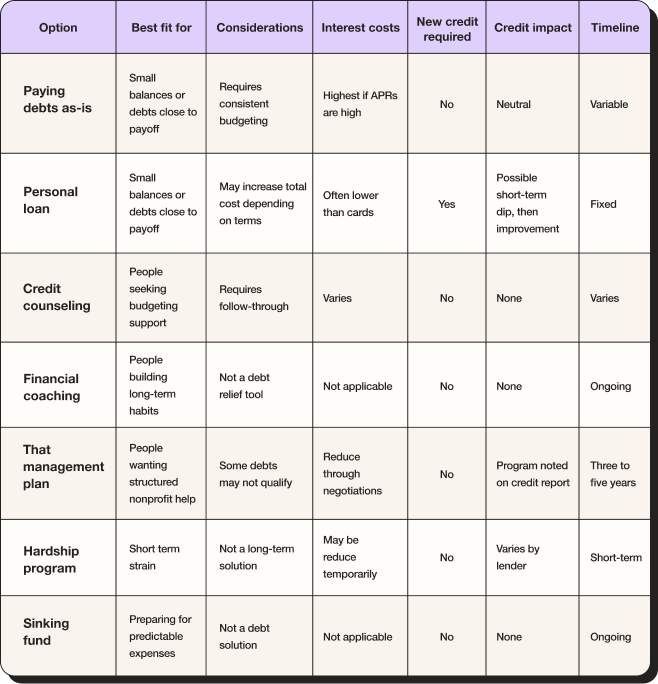
Managing debt can take many forms. The table below shows how debt consolidation compares to other common options in terms of interest rates, credit impact, repayment structure, and potential risks.
What This Comparison Means for You
Debt consolidation loans often stand out as the most stable and structured approach. Alternatives like bankruptcy, debt relief, or settlement can reduce or eliminate debt, but they typically come with long-term credit impacts and financial uncertainty. Credit card refinancing can work in the short term, but it is limited to smaller balances and short payoff windows.
Debt consolidation strikes the right balance for many people. It offers lower interest rates, one predictable payment, and a clear path to strengthen your credit over time. For many borrowers, it provides the balance between immediate relief and long-term financial progress.
Choosing the Right Approach for You
Selecting a debt solution starts with understanding your goals and your ability to stay consistent with payments. The right path balances short-term relief with long-term stability.
When Debt Consolidation May Be the Better Fit
- You want a clear, goal-focused plan for paying off high-interest debt.
- Your income supports regular payments, and you prefer one predictable schedule.
- You’re looking to reduce interest over time and make steady progress.
- You want to strengthen your credit while staying in control of your repayment.
When Other Options Might Work Better
- Bankruptcy: When total debt is overwhelming and repayment is no longer realistic.
- Debt Relief or Settlement: When you need part of your balance forgiven to make progress.
- Credit Card Refinancing: When smaller debts can be paid off quickly during a promotional 0% APR period.
Each debt option serves a purpose. Debt consolidation often provides the most balanced path forward — combining structure, flexibility, and credit protection as you work toward becoming debt-free.
A Personal Loan for Real Progress
The Payoff Loan™ by Happy Money is a personal loan designed to help you take control of your high-interest credit card debt. Checking your rate is free and won’t impact your credit score.