
Overview: Why This Report Matters
Last year we published the inaugural Credit Check-In, an annual study from Happy Money that examines how Americans are feeling about their finances, what actions they’re taking to manage debt, and where they may be missing opportunities to lighten the burden of credit card debt and build momentum toward their financial goals.
The 2026 Credit Check-In surveys consumers today and analyzes what’s changed year over year in how finances are impacting people’s daily lives and where consumers are finding relief when the rate environment isn’t likely to give them any. This year’s study also introduces a few new lenses, including where people are turning for financial guidance in the age of AI.
We found some encouraging takeaways and opportunities to better support the Americans who are looking to do something about their credit card debt.
Executive Summary: A Story in Two Parts
First, the strain is still here, and confidence is slipping at the top end of the scale. Fewer people report being very confident they can meet their financial obligations (34%), even as most still feel at least somewhat confident (73%). What is easing is certainty at the top, not a slide into distress.
Second, people are changing who they trust for help, and AI now has a marked influence on financial guidance and decision-making.
Here’s what stood out most from our survey of 2,000 U.S. adults, nationally representative on age, gender, and region.
Key Findings
- 41% of respondents carry credit card debt, the most common debt type. Among them, 75% are concerned about their credit card interest rates, including 36% who are extremely concerned.
- 33% of respondents said paying down debt was one of their top financial goals, yet only 10% of that group reported consolidating or refinancing debt. Across all respondents, a quarter (25%) reported taking no action at all in the last six months to manage debt or reduce financial stress.
- The barriers to taking action are not only financial. 35% of people with debt say they are too overwhelmed, find it too stressful, or feel it is too much effort. In fact, 25% of those with debt name one of these emotional barriers, not a cash flow problem, as what’s stopping them from taking action on their debt.
- Covering daily expenses (38%), building savings (35%), and paying down debt (33%) remain consumers’ top financial goals this year.
- People carrying debt reported they are putting off building savings (27%), major purchases (26%), and even healthcare or dental care (20%) because of debt.
A Two-Speed Recovery
Ask two Americans how they’re doing financially and you may get two very different answers, and increasingly, the difference comes down to income and generation.
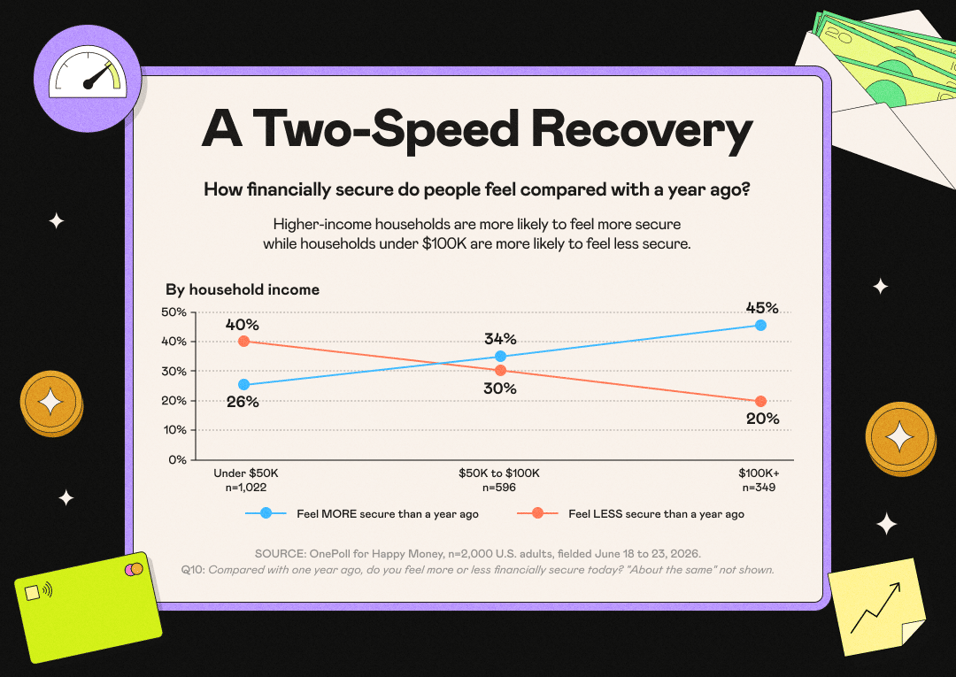
Nearly half of six-figure households (45% of those earning $100K+) feel more secure than they did a year ago. Among households earning under $100K, fewer than 3 in 10 (29%) say the same, and 36% feel less secure against 20% of six-figure households. The slope is steady rather than a cliff: 26% feel more secure under $50K, 34% between $50K and $100K, and 45% at $100K or more.
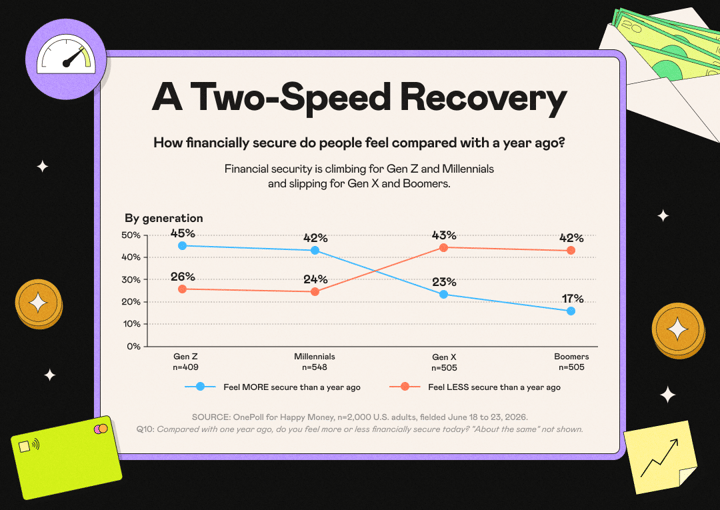
The same divide runs by generation, and it runs opposite to what you might expect. Gen Z and Millennials are climbing: 45% of Gen Z feel more secure than a year ago against 26% who feel less, and Millennials split 42% to 24%. Gen X and Boomers are slipping: only 23% of Gen X and 17% of Boomers feel more secure, while 43% and 42% feel less. This is not income wearing a generational costume. The Gen Z to Boomers gap is 29 points even among households earning under $100K, and Gen Z is one of the lowest-income groups in the study.
“The American consumer continues to show tremendous resilience, but financial progress is becoming more uneven,” explained Matt Potere, CEO of Happy Money. “While many households continue to move toward their goals, others are working harder just to stay in place.”
This isn’t a fragility story. The very-confident number sliding from 41% to 34% is texture on a shifting picture, not a household in crisis. But it is a split, and it’s the kind of K-shaped pattern showing up across the economy right now.
Who Americans Trust for Money Advice
One in 8 Americans (13%) now name AI tools among the sources they trust most for financial advice. Among Gen Z, Millennials, and men, it’s closer to 1 in 6 (17%). This AI use case may be growing because people feel less judged asking an anonymous chatbot a money question they’re embarrassed to ask anyone else.
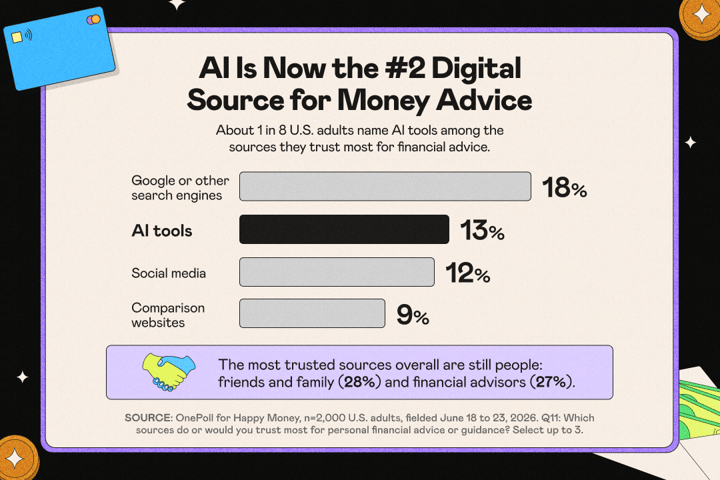
However, AI is mostly additive, not a replacement for personal guidance. Of the people who trust AI for financial advice, 54% also trust a financial advisor, friends and family, an employer program, or a nonprofit debt counselor, and only 14% rely on AI alone. But 46% of those who trust AI (n=256) name no personal or professional source at all, relying instead on search, AI, social and media. That’s the group most exposed if the advice they’re getting is wrong or incomplete.
“AI is a great place to start when you want a quick gut check or you don’t want to ask a person the embarrassing question, but it’s not the finish line,” said Matt Tomko, Chief Revenue Officer of Happy Money. “People still benefit from having a real plan and trusted guidance. That’s where responsible lenders can play an important role, helping consumers make sense of their options and take meaningful steps toward their financial goals.”
Source: OnePoll for Happy Money, 2,000 US adults, fielded June 18–23, 2026.
The Challenge of Managing Revolving Balances
More than a third of cardholders (35%) carry a balance every single month. At today’s rates, that balance compounds fast.
People’s top goal isn’t paying off debt outright, it’s keeping the lights on: covering daily expenses tops the list at 38%, ahead of paying down debt. That finding indicates that debt management has to compete with cash flow, not just willpower.
Deferring Real Life: The Cost of Card Stress
Similar to our 2025 report, we found that credit card stress doesn’t stay in the budget. It shows up in sleep, in mental health, and in what people put off in order to make their household balance sheets work. Among people carrying debt, 1 in 5 (20%) say they’ve delayed healthcare or dental care because of it. Across every milestone we asked about, 80% of people with debt delayed at least one in the past 12 months.
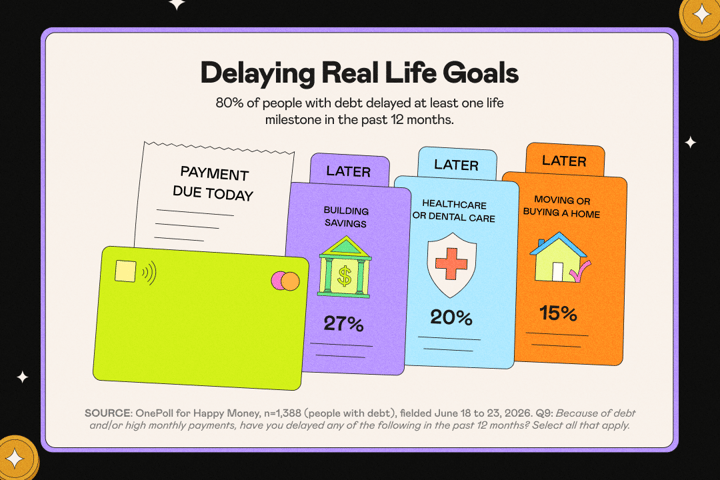
“The Credit Check-In shows that financial pressure continues to shape everyday decisions for many Americans, from cutting back spending to delaying major purchases and even putting health care on the back burner. This isn’t just a debt problem, it’s a life-postponement problem,” said Potere.
Debt Actions: Why Some Strategies Fall Short
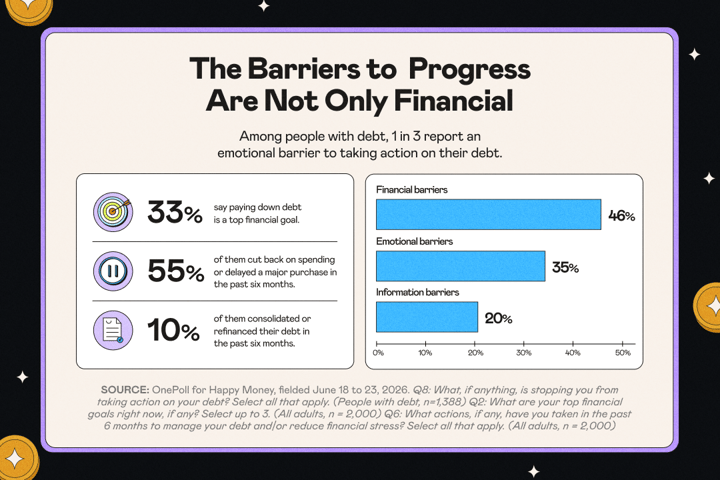
Here’s the gap. Paying down debt is one of people’s top-three financial goals; 33% cited it as a top goal. Nine in ten of that group have taken at least one step in the past six months to manage their debt or reduce financial stress, but those steps skew toward going without. 55% cut back on discretionary spending or delayed a major purchase, and only 10% consolidated or refinanced their debt.
Among all respondents, a quarter (25%) say they have taken no action in the past six months to manage debt or reduce financial stress. Unchanged from a year ago, only 8% of all respondents report consolidating or refinancing their debt. Among the 51% who are concerned about their card interest rates, 11% did.
The barriers to taking action are not only financial: 35% of people with debt say they are too overwhelmed, find it too stressful, or feel it is too much effort. In fact, 25% of those with debt name one of these emotional barriers, not a cash flow problem, as what’s stopping them from taking action on their debt.
“We hear from a lot of people who’d qualify for a personal loan but are still paying rates that price them as riskier than they actually are,” said Potere. “Well-qualified borrowers can often find fixed-rate personal loans running several points below average card rates. That’s not a marginal difference, it’s real money left on the table.”
Nearly 1 in 4 Americans (23%) say they are not confident they can meet their financial obligations over the next six months. Almost half of them carry credit card debt, and those who do are less likely to have consolidated or refinanced than card-debt holders who feel confident (8% against 14%). That is exactly the gap a well-structured personal loan is built to close.
Tools to Support Financial Progress
A smart financial plan uses the right tool for the job. None of these are universal, but each one is worth knowing about and evaluating for your own unique financial situation.
- Budgeting & Planning: A clear monthly budget is still the starting point for every other decision on this list.
- Personal Loans for Debt Consolidation: A fixed rate, one payment, and a defined payoff date, often at a meaningfully lower rate than revolving card debt.
- Home Equity Lines of Credit (HELOCs): For homeowners with equity, a HELOC can fund a large expense at a lower rate than a credit card, with the home as collateral.
- Buy Now, Pay Later (BNPL): Flexible at checkout, harder to track across multiple plans, and increasingly visible to credit scoring.
- Negotiating with Your Card Issuer: Many people don’t realize they can call their own credit card company and ask for a lower rate or revised terms. While it doesn’t always work, it costs nothing to ask. This is different from debt settlement, where a third party negotiates to pay less than what you owe, which can carry fees and affect your credit.
How Smart Borrowing Supports Faster Progress
Consider this scenario. Someone carrying $20,000 in credit card debt at the average rate for accounts assessed interest (22.15%, per the Federal Reserve) making a $580 monthly payment would take roughly 55 months to pay it off, and pay about $12,091 in interest along the way.
Move that same $20,000 into a fixed-rate personal loan at the national average rate for unsecured personal loans (12.41% APR, per Bankrate), keep paying the same $580 a month, and the math changes: paid off in 43 months, with roughly $4,861 in total interest.
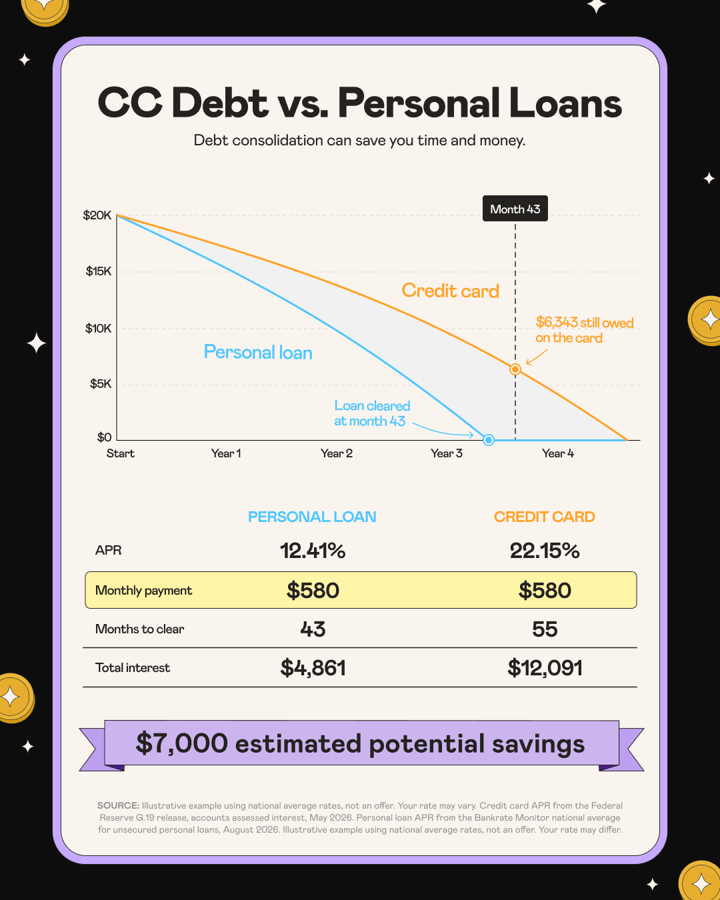
That’s about $7,000 saved in interest and nearly a year off the payoff timeline. If you’re juggling multiple credit card payments, a fixed-rate personal loan can simplify things with one monthly payment, one rate, one set payoff date. Happy Money’s loan payment calculator gives you a clear estimate of your monthly payment, total interest, APR, and term, so you can see the real numbers before you apply for a personal loan.
Methodology footnote: Card-side assumptions: $20,000 starting balance, $580 monthly payment, 22.15% APR (Federal Reserve G.19 release, commercial banks, accounts assessed interest, May 2026). Loan-side assumptions: $20,000, 12.41% APR (Bankrate Monitor national average for unsecured personal loans, August 2026), same $580 monthly payment. A 48-month loan at 12.41% carries a $531 minimum payment; keeping the $580 already going to the card is what clears it in 43 months. Individual rates and savings vary by credit profile. Scenario is for illustrative purposes only.
How Financial Institutions Can Help Close the Gap
Credit unions and banks have an opening here. By offering well-structured personal loans, they can support their members’ actual top goal (covering daily expenses, not just debt payoff), build loyalty, and diversify into a high-quality, short-duration asset.
The demand is already there. About 1 in 5 people already hold a personal loan (20%), and nearly the same number (18%) say they’re in the market for a personal loan or debt consolidation product in the next six months.
“Financial institutions that offer responsible credit solutions are well positioned to attract new members and strengthen the relationships they already have,” said Potere.
Takeaway for Lending Leaders
A personal loan program can reduce portfolio risk through short-term, high-yield assets and unlock long-term growth at the same time.
Learn about partnering with Happy Money. →
About Happy Money
Happy Money is a consumer finance company that empowers people to achieve their goals through responsible lending. Together with our capital partner network, Happy Money has originated over $7 billion in personal loans, helping more than 350,000 people take greater control of their financial future. Learn more at happymoney.com.
Check your rate with no impact to your credit score. →
About the Report: 2026 Methodology
This online survey of 2,000 U.S. adults (nationally representative on age, gender, and region) was commissioned by Happy Money and conducted by OnePoll, in accordance with the Market Research Society’s code of conduct, between June 18 and June 23, 2026. All participants are double opted-in. OnePoll is an MRS Company Partner and a corporate member of ESOMAR.
